



The short answer: spec the chain, not the sight
The surest path to the wrong duty optic is to start with optics. A duty red dot is the last link in a chain of commitments, and the chain gets specced in order:
- Emitter housing. Closed or open is the duty-exposure question — answered by policy and trial against manufacturer documentation, not by catalog appeal.
- Footprint. The mounting interface is the real commitment; it outlives any single optic model.
- Power logic. Battery type, listed runtime, and change access — at fleet scale the answer is a calendar, not a number.
- Dot geometry. A described choice, not a prescribed one; the trial window decides what the spec sheet cannot.
- The holster. Every optic choice re-runs the fit matrix: pistol, optic, light.
The rule that carries this guide: no optic is selected until its holster exists.
This is the selection half of a system whose other half is already written. The holster-first transition guide explains why the holster matrix gates an optics program; this piece is how the optic itself gets specced while that matrix is being built.
The emitter question: closed or open
Every red dot puts a small emitter behind a window. Closed designs enclose the emitter path and window in a housing; open designs leave the emitter exposed above the window. Manufacturers describe their housings in exactly these terms, and the housing line on a listing is where a duty comparison starts.
The reason this is the first link: a duty pistol does not live on a range bag shelf. It rides outdoors, in weather, against a uniform, through everything a shift includes — and how a housing handles that exposure is a claim each manufacturer makes for its own design. Read those claims in the documentation, then let your trial window test the ones that matter to your climate and your policy. We describe; the documentation and your trial answer.
Decide the housing question first, on exposure, and the rest of the chain gets shorter — it writes itself into every later link, the holster included.
Footprint is the commitment
Under every slide-mounted dot is a mounting interface — the footprint. Footprints come in families, and adapters exist precisely because footprints are the interop layer between optics and slides.
One carried example makes the point by itself: the Viridian RFX45 is listed for the ACRO footprint and ships with an RMR adapter — one optic, two mounting interfaces, per its own listing. That is the footprint system in miniature.
Fleet slides take optics through mounting plates or direct milling. Which method, and for which footprints, is manufacturer-documentation territory — the pistol maker’s and the optic maker’s both — and every pairing gets verified by your armorer before it becomes fleet policy. We describe, you verify.
Here is why footprint outranks optic model in the spec order: the footprint decision outlives the optic that prompted it. The plate inventory, the armorer tooling, the replacement path when an optic goes down mid-year — all of it keys to the footprint, not the model name. Standardize on the footprint the fleet’s slides accept, and let optic models compete inside it for as long as the program runs.
Power at fleet scale
Battery questions look small at quantity one and become supply lines at quantity fifty.
Three reads, all off the listing. First, the cell type — consolidating on as few battery types as the chosen optics allow is ordinary quartermaster logic; one cell type across a roster is a supply line, five is a junk drawer. Second, the runtime — a listed number, read per model from its listing, not from forum memory. Third, change access — designs split between change-in-place and remove-to-change, and for the second kind a battery change is a remount, which means the manufacturer’s re-zero guidance applies each time. That difference belongs in the written spec, because at fleet scale it is armorer hours.
The fleet policy that falls out is a change calendar per manufacturer guidance — not a run-to-failure maximum. Batteries on a calendar are a line item; batteries left to chance are a mid-shift surprise. The new-fiscal-year planning guide has the program logic this slots into: a standing replacement line with an owner.
Dot geometry and the trial window
Dot size is a listed number, in MOA. Two carried examples: the Burris FastFire IV lists a 3 MOA dot with multiple reticle options; the RFX45 lists 5 MOA. The listing gives the geometry.
What the listing cannot give is how a given dot presents to a given officer’s eye under a given shift’s lighting — presentation varies by eye and by light, and that is precisely the question a trial window exists to answer. No spec sheet closes it; no purchase should get ahead of it.
Run the trial like a spec panel, the same way the two-number light read works for duty lights: a small panel, defined questions — housing behavior, dot presentation, mounting confidence — and a written record. The listing supplies numbers; the panel supplies verdicts. Show season lands conveniently in the first quarter of the budget year, and walked correctly an expo floor lets a panel handle a year’s worth of housings in an afternoon.
The sight change that rides along
An optics transition usually carries a second, quieter sighting decision: the irons. Slide-mounted optics change the iron-sight picture, which is why suppressor-height sets exist as a class — sights tall enough to work alongside an optic install.
Two carried examples, both with tritium illumination per their listings: the Suppressor Height Night Sight Set for Sig P320/P365 and the TruGlo TFX Suppressor Height Sights, which add fiber-optic elements. Whether your fleet requires irons alongside the optic, and in what configuration, is policy — the point here is only that it is decided at optic-selection time, not discovered after the plates are ordered.
The holster consequence
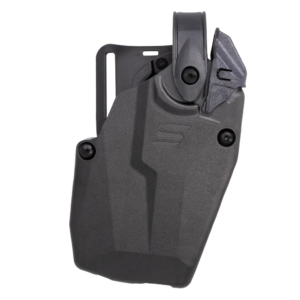
Everything above converges on the link that gates the whole chain. Holster fit runs per pistol, optic, and light combination — duty holsters are built model-specific around exactly that trio. The Safariland 7360RDS for the Glock 17 MOS says it in its own listing: an optic-ready cut that “clears a slide-mounted red dot without giving up the locking hardware.” Multiply that specificity across a roster’s pistols and lights and you have the fit matrix — the duty holster wall is organized around precisely these combinations.
So the transition guide’s rule closes the selection guide too: no optic is selected until its holster exists. A candidate optic with no duty holster for your pistol-and-light combination is not a candidate yet — it is a watch item. Check the holster chain before the trial, not after the committee has fallen for a window.
Where 911 Network fits
Honestly: we sell more of the chain than the sight. The duty holster wall and the optics category are here to browse, and the iron-sight and carriage pieces of a transition are deep on the shelf. The duty-optic shortlist itself comes out of your spec panel, read against manufacturer documentation — and when a chain will not close, a footprint without a plate or an optic without a holster, that is a Gear Desk conversation.
FAQ
Should a duty red dot be closed or open emitter? Closed housings enclose the emitter path and window; open designs leave the emitter exposed. Manufacturers describe their housings in exactly these terms, and the housing line on a listing is where a duty comparison starts. Which one a duty environment demands is an exposure question your policy and trial window answer against the manufacturer’s documentation — there is no blanket answer.
What red dot footprint should a department standardize on? The footprint the fleet’s slides and plates accept per manufacturer documentation. The footprint is the mounting interface, and it outlives any single optic model — adapters exist precisely because footprints are the interop layer. Your armorer verifies every pairing before it becomes fleet policy.
How long do duty red dot batteries last? Whatever each optic’s listing states — runtime is a listed number, read per model. At fleet scale the working answer is a change calendar per manufacturer guidance rather than a run-to-failure maximum, and for designs where a battery change means removing the optic, the manufacturer’s re-zero guidance applies each time.
Do red dots require new duty holsters? Usually, yes. An optic changes the holster fit, and fit runs per pistol, optic, and light combination — duty holsters are built model-specific with optic-ready cuts. The holster-first transition guide covers the fit matrix and the audit that keeps a fleet ahead of it.
More buyer guides live in the Resource Center. And when the list is ready: send the fleet list — pistols, plates, and holsters as they stand — and the Gear Desk will tell you which chains close.