


The short answer
Safariland introduced HOLLE at SHOT Show 2026 and started shipping it this spring. Per the manufacturer, it’s a duty belt that keeps the traditional profile while changing how gear attaches to it: accessories hard-mount to the belt in 3/4-inch increments — without keepers or threading pouches on — and reposition without unloading everything ahead of them.
Whether that matters to your unit comes down to three questions, and they’re the same three for any belt-system change:
- What does it fix that your officers actually suffer? Safariland’s claims target pouch sag, the dead space at the belt overlap, re-threading churn, and lost keepers.
- What carries over? Per Safariland: ELS, QLS, and TQP accessories are compatible, and traditional belt-loop pouches still slide on.
- What’s the switching cost? Belts plus HOLLE-pattern pouches, per officer — which makes this an audit-first program, not an impulse buy.
The rest of this piece unpacks the system, sourced to what Safariland has published — we haven’t run it on a belt line yet, and this guide doesn’t pretend otherwise.
Now listed: HOLLE is in our catalog in all four buckle styles: CopLok, Cobra, Sam Browne and buckleless, plus the HOLLE-mount holster belt loops. See the full HOLLE line. Buying for a trial or a whole unit? The quote desk handles it.
How duty belts carry today
The system HOLLE wants to succeed has worked for decades, and its frictions are familiar to anyone who has set up a belt. Pouches and holders thread onto an outer belt — a Model 7200-style duty belt — in a fixed order, so changing one item in the middle means unloading everything ahead of it. Belt keepers clamp the loaded outer belt to an inner belt, and they loosen, migrate, and occasionally disappear. The buckle overlap eats a stretch of real estate nothing can occupy. And a threaded holder sits where the threading put it, not necessarily where the hand wants it.
None of that is a crisis — it’s a mature system with known trade-offs, and it’s what the belt wall is built around today. It’s also the honest baseline for judging what Safariland says it changed.
What Safariland says changes
From the manufacturer’s release (The Outdoor Wire, May 2026; introduced in Safariland’s SHOT 2026 announcements):
- Hard-mounted accessories. Pouches mount to the belt itself rather than threading over it, and adjust or reposition without unloading the belt.
- 3/4-inch incremental placement. Gear lands where you put it, in repeatable increments, rather than where threading tension leaves it.
- Vertical or horizontal mounting. The four-hole HOLLE pouch pattern mounts either orientation.
- Canting hardware. Spacers and hardware can angle pouches away from the body — the release frames this as easier grasp.
- Hard-mounted holster positions. Dedicated belt mounts (QUBL2, VUBL2, CUBL2) with mid- and hi-ride options.
- Buckle choices. Sam Browne, Coplok, and Cobra configurations, plus a buckleless option.
- Redesigned keepers. Accessories mount without keepers — and the belt keepers the system does use are designed, per the release, to stop being the thing you lose.
Worth saying plainly: those are the manufacturer’s descriptions of its own system. They’re specific and testable, which is what makes them useful — but they’re claims, not our field notes.
What carries over
For a quartermaster, this is the section that decides whether HOLLE is an evaluation or an ecosystem swap. Per Safariland, the system is compatible with its existing tactical accessory interfaces — ELS, QLS, and TQP — and traditional belt-loop accessories can still slide onto the belt.
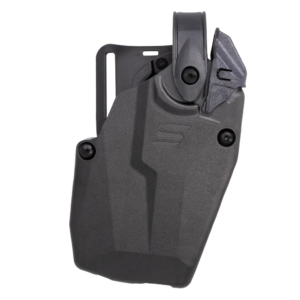
Concretely, that means hardware many fleets already run is part of the conversation: a QLS 19 holster fork and QLS 22 receiver plate setup — or a holster that ships QLS-equipped, like the 6354RDSO we featured in the red-dot holster guide — doesn’t automatically become obsolete on a HOLLE belt. Neither does the drawer of threaded pouches, if the slide-on path holds up in practice.
That compatibility story is also the first thing to verify in a trial, because it’s the difference between “new belts” and “new everything.”
The claims worth testing
Safariland’s stated benefits — less pouch sag over duty wear, less dead space at the overlap, no re-threading to change a loadout, keepers that stop going missing — are all things a unit can check rather than take on faith. That’s a trial-and-evaluation list, not a purchase justification: a few belts, a few officers, a full duty cycle, and notes on whether the frictions the release names are frictions your unit actually had.
Each claim maps to something recordable, which is what separates a trial from an opinion:
- Sag — photograph pouch positions at issue and again at the end of the trial period, same officer, same loadout.
- Overlap space — count what fits on the trial belt against the same officer’s current belt.
- Repositioning — time a mid-belt loadout change on both systems.
- Keepers — track replacements requested during the trial against your normal keeper burn rate.
The duty holster wall taught us this pattern already: systems that change how gear mounts live or die on fitment details that only show up in use.
Should your unit care yet?
If your belts and keepers are mid-lifecycle and nobody’s complaining, launch news is not a reason to change — a mature system that works is worth keeping. If belt churn is a real cost center for you — constant loadout changes, keeper replacement, officers fighting pouch placement — HOLLE is worth the three questions and a small trial.
What it should not be is a fleet decision made at speed. A belt-system change touches every officer, every uniform policy line about gear placement, and every pouch in the supply room — which makes it exactly the kind of per-officer program our year-end budget guide files under audit-first: map what you run, map what carries over, and only then put a number on the switch. One spec per class still applies; it just applies after the trial, not before.
FAQ
What is the Safariland HOLLE system? HOLLE is Safariland’s duty belt system introduced at SHOT Show 2026. Per the manufacturer, it hard-mounts accessories to the belt in 3/4-inch increments — without keepers or threading pouches onto the belt — while keeping a traditional duty profile, with pouches that mount vertical or horizontal and Sam Browne, Coplok, Cobra, or buckleless configurations.
Does HOLLE work with existing Safariland accessories? Per Safariland, yes: the system is compatible with ELS, QLS, and TQP tactical accessories, and traditional belt-loop pouches can still slide onto the belt. That means QLS-mounted holsters and existing pouch inventories are part of the evaluation, not automatic replacements.
Do you still need belt keepers with HOLLE? Per Safariland, accessories mount without keepers or threading. The system does still include belt keepers — redesigned ones the release says are aimed at eliminating lost or dropped keepers. The practical change is at the pouch: mounting no longer depends on clamping gear over an inner belt.
Should agencies switch duty belt systems now? Not on launch news. Run three questions first — what it fixes for your unit, what carries over, and what switching costs across every officer — then a small wear trial before any fleet decision. A belt-system change is an audit-first program, the same logic as any per-officer gear transition.
More field notes and planning guides live in the Resource Center. And on the obvious question: we’ll be carrying HOLLE. For timing — or to talk through what carries over from the belt system you’re running now — ask the Gear Desk.